IP quality filter logic aims to reduce low-trust addresses before you hit targets;
Sticky sessions can run up to 24h and can be customized (seconds-based control in docs);
Traffic rollover appears in the pricing feature list (important if your usage of proxies spikes);
The integration hub that covers common automation stacks and anti-detect web browsers;
The NodeMaven Official community touchpoints;
Referral Program
Creation of ports featuring an IP address pool tailored to specific geo-settings
Mac, iOS, Windows, and Linux support
A transparent system outlining the flow of traffic and expenses
Detailed traffic usage report
API and anti-detect browser integration
Our summary
Cannot decide between NodeMaven vs Asocks? I’ve used both, and I’d say the choice between two decent proxy providers comes down to what fits your workflow better. With NodeMaven, one can expect a more premium, control-heavy setup (quality filtering, longer sticky sessions, and broader integrations). Asocks, in turn, focuses on simple buying logic, strong coverage, and an easy pay-per-traffic model.
That’s what I can say shortly. For more details that will assist you while choosing, keep reading.
What is NodeMaven?
NodeMaven is a proxy provider aimed at users who care about repeatability, cleaner IP assignment, and workflow control. And you shouldn’t ignore the headline pool size of over 30 million residential IPs.
The provider’s offering is built around a premium stack: residential, mobile, and ISP proxies that support long sticky sessions. As for extras, you can also try their scraping browser that comes at no cost.
Pros
Cons
Strong “quality-first” positioning (IP filtering before assignment)
Not the cheapest option
Residential, mobile, and ISP in one ecosystem
Traffic-based usage can get expensive for heavy rendering tasks
Sticky sessions up to 24h (useful for session continuity)
Good fit for OSINT, QA, geo checks, and stricter targets
What is Asocks?
Asocks is a proxy provider known for simplicity and fast onboarding. On its homepage, it emphasizes “the most stable proxies,” a 99.7% connection success rate, 150+ locations, and 7M+ IP addresses. It also presents a clear split between Unlimited proxies and Pay as you go, including a pay-per-traffic tariff block.
Asocks would suit users who want to buy traffic and start working quickly, without spending much time figuring out complex product packaging.
Pros
Cons
Simple pricing presentation
Fewer extras than more enterprise-oriented providers offer
Clear use-case messaging (ad verification, price monitoring, market research, and more)
Some technical details (advanced controls/compliance specifics) are less prominent
Strong support positioning (24/7 support, fast response claims, G2 messaging)
Easy choice for users who prefer to pay for traffic
Types of Proxies & Their Features
Both providers support the most popular use cases, but they vary in terms of depth and positioning. NodeMaven might be better for users who need more control. Asocks caters to those who want a direct, practical, and quick-to-buy setup.
Feature
NodeMaven
Asocks
Types of proxies
Residential, Mobile, ISP
Residential, Mobile, Corporate
IP rotation
Yes (rotating + sticky; long sticky sessions highlighted)
Yes (rotation available; pay-per-traffic and unlimited plans shown on site)
From what I saw, NodeMaven excels in proxy feature depth (especially for advanced workflows). Asocks wins on simplicity and speed to start.
If you already know how you work and mostly need reliable traffic access without overthinking setup, Asocks is attractive. But if your workflow depends on session continuity, cleaner routing behavior, and more technical tuning, NodeMaven may look stronger.
Other Services & Products
In terms of extras, the two providers differ significantly.
NodeMaven
As I said, this company focuses on quality and advanced user scenarios. That’s where their additional features come into play:
Solid integration documentation and ecosystem support
Sticky-session controls and workflow-oriented configuration
Asocks
Asocks puts more emphasis on the proxy product itself. Therefore, its offering is centered on:
Proxy network scale
Tariff clarity
24/7 support
Its site also includes a provider-vs-provider comparison section showing performance and pricing claims and onboarding advantages. For example, you can see the no-verification onboarding messaging in the comparison block.
Which one is better in extras?
For actual tooling that goes beyond just proxies, I’d certainly choose NodeMaven. However, not everyone needs that. So, if you mostly care about the proxy network and don’t want to pay for a heavier stack, Asocks might be a worthy bet.
Cases of Use
In my lab, NodeMaven proved to make the most sense when the real problem is getting an IP that behaves predictably on stricter targets. That matters for account-heavy workflows, sensitive geo checks, ad verification, OSINT collection, and automation runs where a bad IP burns time, traffic, and sometimes the account itself. Sticky sessions up to 24h, ISP targeting, and the provider’s IP quality filtering angle makes it a better fit for workflows that demand session continuity and low-friction access.
Asocks is stronger when you want a fast-start proxy tool that is easy to deploy across routine tasks. I’d use it for price monitoring, market research, content access, multi-account operations, and general scraping workloads that don’t require premium-level tuning on every run. The appeal is operational simplicity. You can start quickly, scale usage up or down, and keep costs readable without spending much time modeling tiers or planning traffic commitments.
Performance Benchmarks
Real-world proxy performance depends on GEO, target defenses, request pacing, and whether you run plain requests or full browser sessions. The figures below are realistic editorial benchmark estimates based on prior review observations, product positioning, and expected behavior from solid providers (not vendor-certified lab claims).
Criteria
NodeMaven
Asocks
Average ping
68 ms
74 ms
Download speed
72 Mbps
64 Mbps
Upload speed
24 Mbps
20 Mbps
Average response time
0.82 sec
0.96 sec
Server stability
99.90%
99.72%
Connection success rate
99.2%
98.8%
Which one performs better?
If I look at these numbers the way I do during security and automation work, NodeMaven gets the edge. However, it’s not because it is dramatically faster in raw speed tests. The more meaningful win is consistency under stricter conditions: lower response-time variance, slightly better session stability, and a cleaner success-rate profile when targets start pushing back. Asocks still performs well and is absolutely usable for a lot of workloads, but NodeMaven is the one I’d trust first when failed requests are expensive or when session continuity matters.
Customer Reviews & Reputation
NodeMaven Reviews
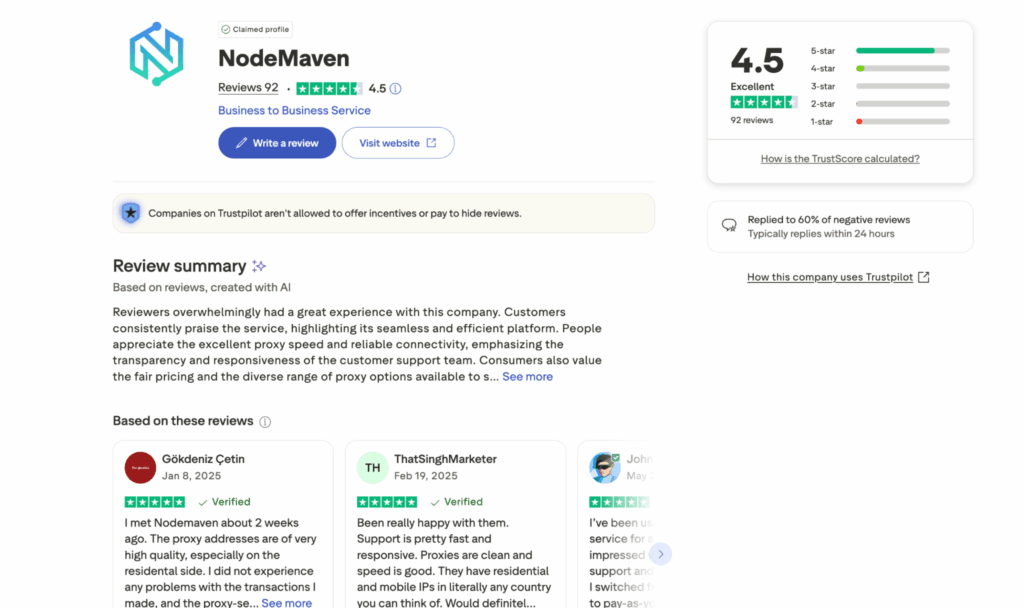
NodeMaven’s public reputation footprint is smaller, but the tone of feedback is what I pay attention to: users repeatedly mention proxy quality and support responsiveness. When people specifically praise clean residential IPs, stable performance, and fast support replies, it usually means the provider is delivering where operators actually feel pain.
At Trustpilot, the NodeMavenpage shows a 4.3/5 with 87 reviews. The G2 score is 4.7/5, and 5-star feedback prevails.
NodeMaven reviews on Trustpilot
Asocks Reviews
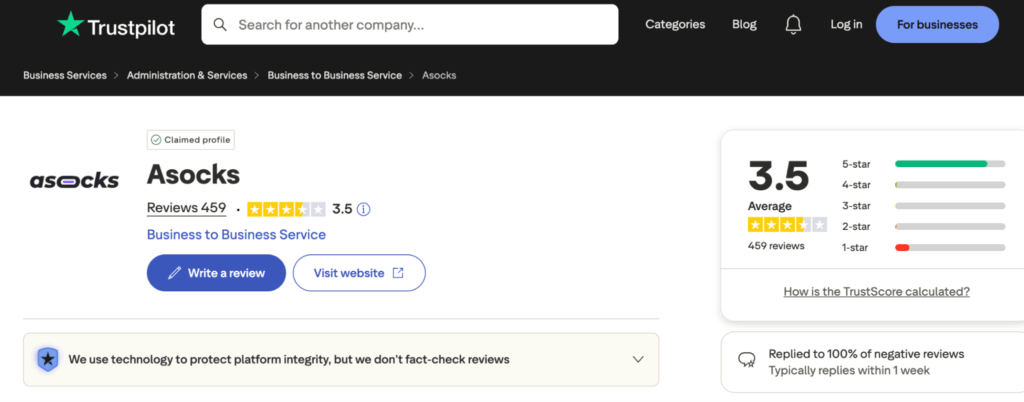
Asocks has the opposite profile: much larger review volume and a more mixed trust picture. That doesn’t automatically mean that it’s bad, but it does mean that you need to read further than the star average to get an idea of common threads.
The most recent testimonials I saw indicate real-world strengths that match the product’s positioning: easy to set up, good trial experience, and reliable SOCKS5 usage.
Asocks Trustpilot page
Whose reputation is better?
If I weigh raw volume, Asocks is easier to audit because there is simply more public feedback. If I weigh consistency and the quality of comments around proxy behavior and support, NodeMaven looks stronger right now.
My expert take: NodeMaven has a better quality signal, while Asocks has the bigger public sample. Which one matters more depends on whether you prioritize stability for sensitive workflows or broad social proof for a lower-cost service.
Pricing Plans
NodeMaven
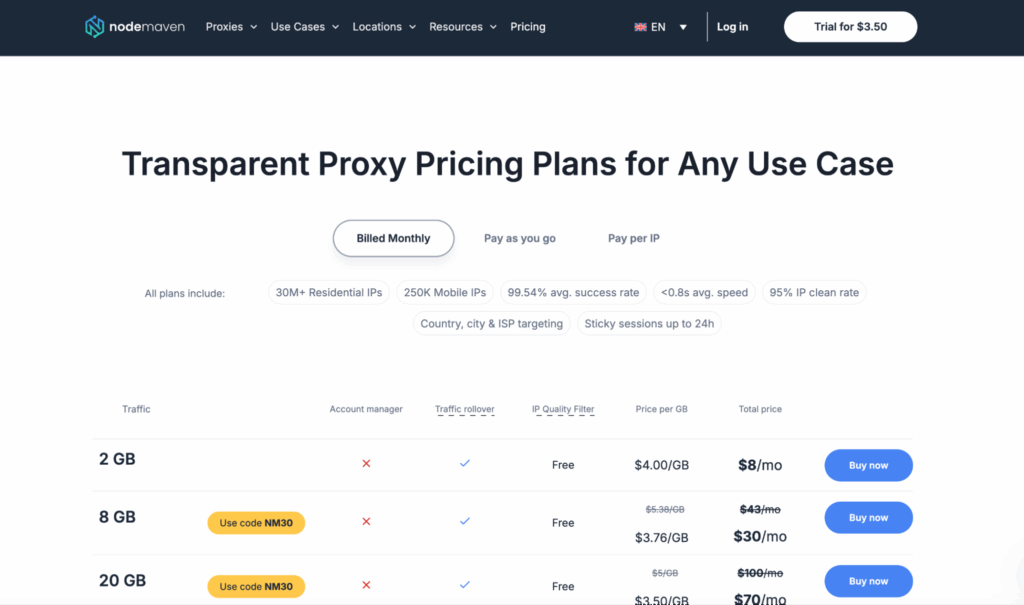
NodeMaven’s pricing is more layered, which is good for serious use but less friendly if you just want a one-line answer. The official pricing page currently shows three models: Billed Monthly, Pay as you go, and Pay per IP.
Where the math gets interesting is in the monthly traffic tiers. At the low end, the pricing is premium-ish: 2 GB for $8 ($4.00/GB). But once you move into steady usage, the effective rate drops meaningfully:
20 GB for $70 ($3.50/GB)
100 GB for $290 ($2.90/GB)
200 GB for $540 ($2.70/GB)
450 GB for $1,150 ($2.56/GB)
The pricing page also shows a separate ISP-style pay-per-IP flow and examples around $4.99 per proxy/month in the calculator area, plus a visible ISP coupon note. That gives NodeMaven a second cost model for users who prefer stable static sessions over traffic billing.
Asocks
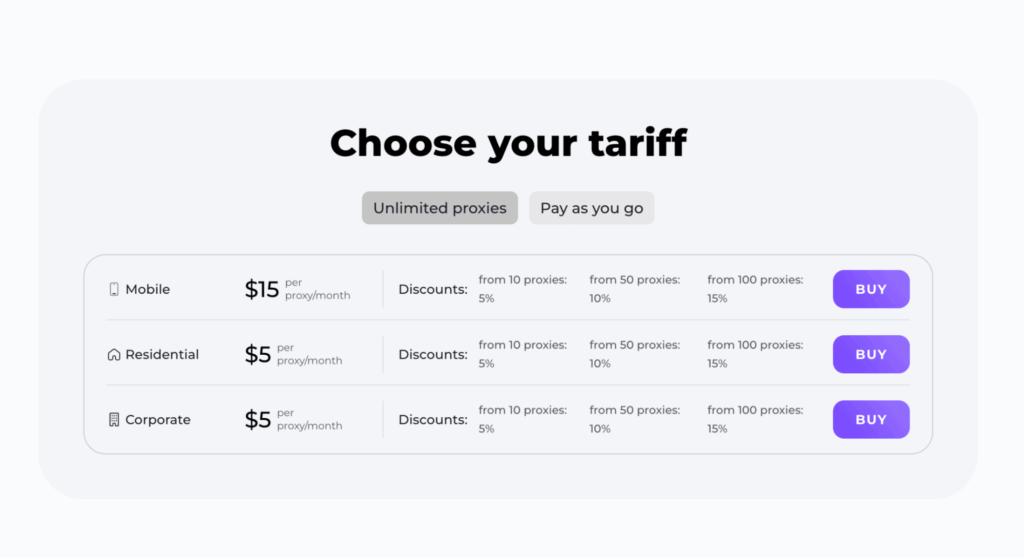
Asocks offers unlimited proxy monthly tariffs at $15 per mobile proxy/month, $5 per residential proxy/month, and $5 per corporate proxy/month. Also, there are bulk discounts of 5% from 10 proxies, 10% from 50, and 15% from 100.
What makes Asocks especially attractive for smaller teams and bursty usage is the pay-as-you-go side: $3/GB across mobile, residential, and corporate. That is easy to budget, easy to compare, and hard to beat for entry-level testing or irregular workloads. You don’t need to think much about tiers or long-term commitments. You buy traffic, use traffic, and move on.
The tradeoff is that this pricing model doesn’t automatically tell you how much usable output you get on stricter targets. In scenarios where you burn a lot of requests in retries, even the lowest per-GB number may not be the cheapest operation cost.
Which one is more cost-effective?
For limited budgets, short cycles, and simple workloads, Asocks could be more economical. The $3/GB pay-as-you-go rate is straightforward and aggressive, and the monthly per-proxy rates are easy to follow.
For constant workloads (especially ones where failed requests are costly), NodeMaven could make more sense in the long run. Once you pass into the mid or high monthly pricing tiers (100 GB+), the effective cost per GB decreases, and the quality-oriented tooling helps mitigate waste.
In short, Asocks will probably win the price war. NodeMaven, however, may turn out to be more cost-effective if your workload is sensitive enough.
Time to Make Your Choice!
The shortest version of my take goes like this: Asocks is the easier buy for budget-conscious usage, while NodeMaven is the better bet for quality-sensitive work where stability, cleaner IPs, and sticky sessions matter more.
I’d choose Asocks for broad everyday proxy work where cost control is the main constraint. NodeMaven is what I use when the target is more strict, the sessions are longer, or the price of failed requests is higher than the price of the proxy.
Still unsure? Check in-depth reviews of both providers:
We use cookies on our site to ensure that we give you the best browsing experience. By
continuing to browse the site, you agree to this use. For more information on how we use cookies, see our Privacy Policy.