IP quality filter logic aims to reduce low-trust addresses before you hit targets;
Sticky sessions can run up to 24h and can be customized (seconds-based control in docs);
Traffic rollover appears in the pricing feature list (important if your usage of proxies spikes);
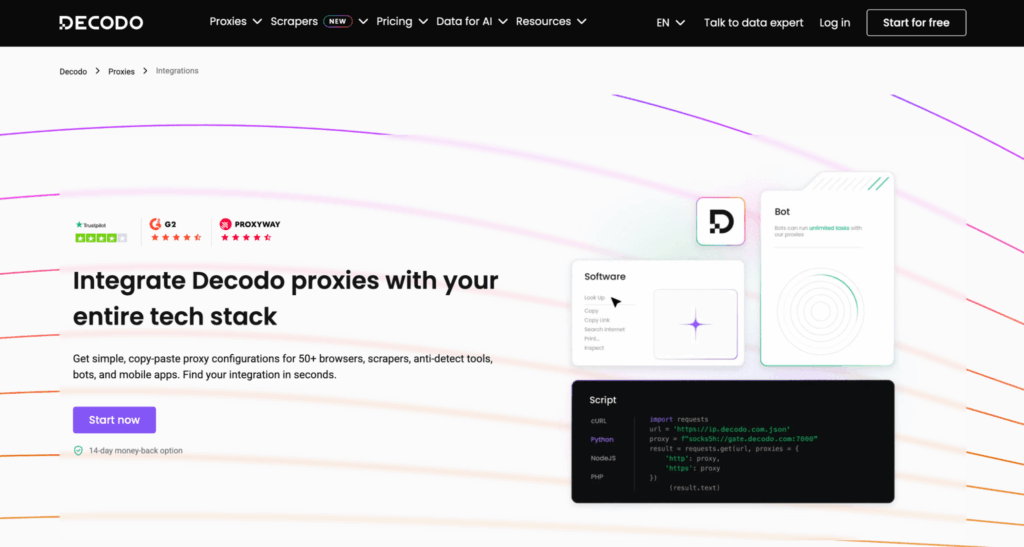
The integration hub that covers common automation stacks and anti-detect web browsers;
The NodeMaven Official community touchpoints;
Chrome and Firefox extensions
Unlimited threads
Proxies without subnets
Proxy Address Generators
Free X Browser
Multi-profile management
Lightning-fast proxy setup
Unique fingerprints galore
Our summary
NodeMaven is the better pick if you want a proxy-first setup with tighter session control and stronger quality-focused handling. On the other hand, we have Decodo, which is a broader platform solution with more extras on offer. Below, you’ll get the complete comparison that should help you choose based on your needs and budget.
What is NodeMaven?
NodeMaven is a proxy provider focused on automation, scraping, and multi-account use cases, with a product lineup centered around residential/mobile/static proxy access and practical controls like sticky sessions and rollover traffic. Its docs and integration coverage target real operator workflows rather than generic browsing use. NodeMaven’s positioning is especially appealing for users who want proxy performance and session control first, and “extras” second.
Pros
Cons
Strong proxy-first focus
No free trial (vs Decodo)
Sticky sessions up to 24h
Fewer extra products and tools
Traffic rollover
Broad anti-detect integration compatibility (per your list)
Good fit for teams that already have their own scraping logic or tooling
What is Decodo?
Decodo, previously known as Smartproxy, is a proxy and web data infrastructure company that has been in business for quite a long time. It has a wide range of products in its portfolio, including proxies, scraper APIs, and unblockers. The company was founded in 2018 and boasts 125M+ ethical IPs in 195+ countries. It is a strong choice for teams that want one vendor for proxies plus adjacent scraping tools and integrations.
Pros
Cons
Large IP pool and global reach (125M+, 195+)
Price/value may be weaker than niche providers for proxy-only use
Very broad integrations ecosystem (500+ tools/integrations)
A slightly steeper learning curve for beginners
Multiple extra products (Scraper APIs, Site Unblocker, free tools)
Free trial available (7 days)
14-day money-back option
Types of Proxies & Their Features
Both of these services meet the basic proxy requirements, although they were developed with different priorities in mind. NodeMaven is more proxy-centric, with a greater focus on session control and usability in an anti-detect or account-based environment. Decodo, in turn, offers its proxy service in addition to a suite of other scraping and automation tools.
That makes the real difference less about proxy availability and more about workflow fit. The table below focuses on the practical features that matter most in daily use.
If the question is strictly about proxy use quality (especially for anti-detect setups, account operations, and stable sessions), NodeMaven has a strong case because its feature set feels built around day-to-day operator pain points: IP quality filtering, long sticky sessions, and practical browser/tool integrations.
If you need a provider that can also support a wider technical stack beyond proxies, Decodo becomes more attractive. Its proxy offering is still competitive, but the real advantage is how easily it fits into larger scraping and automation workflows.
Other Services & Products
Both NodeMaven and Decodo support a wide range of third-party tools. So this is not really a contest of who has integrations. The more useful question is what sits around those integrations and how each provider positions itself in an actual workflow.
NodeMaven
NodeMaven keeps its ecosystem tightly connected to proxy usage itself. Its integrations lean heavily toward anti-detect browsers, automation frameworks, and proxy-routing tools, which makes sense given its overall positioning. I’d say the service feels built for users who already know what they want to do with proxies and mainly need clean sessions, stable routing, and compatibility with the software they already use.
What stands out more than the raw number of integrations is that NodeMaven pairs that compatibility with workflow-oriented proxy features. The service puts a lot of emphasis on sticky sessions, traffic rollover, IP quality filtering, and scraping-browser functionality for tougher targets. So its extras are not especially wide, but they are closely tied to the core proxy product.
Decodo
Decodo also supports a large number of integrations across browsers, anti-detect tools, scraping frameworks, and automation software. However, it goes further by packaging those connections inside a larger commercial ecosystem. In other words, Decodo is also selling surrounding infrastructure for scraping, automation, and data collection.
That wider scope is where Decodo separates itself. Alongside proxy compatibility, it offers products such as scraper APIs, Site Unblocker, browser tools, and setup resources for different user types. For teams that want to centralize more of their stack under one provider, that broader product layer can be more valuable than the integration count itself.
Which one is better in extras?
NodeMaven’s extra value stays close to the proxy itself: better session handling, traffic efficiency, filtering logic, and compatibility with the kinds of tools proxy users rely on every day. Decodo’s extra value is broader and more platform-like. It offers users more options than just proxies, which can be helpful if your team needs scraping APIs, an unblocker, or a more complex data collection setup.
That being said, NodeMaven looks more suitable for a leaner proxy-based environment. But if the toolkit is important for you, then Decodo has a better extras package.
Cases of Use
NodeMaven is a strong fit for users who care about the quality of proxy sessions more than the number of extra products in the dashboard. It can be useful for anti-detect browser configurations, multi-account management, e-commerce research, or ad verification. In other words, all sorts of activities where session stability and painless IP handling are important.
Decodo is better suited to teams that treat proxies as part of a larger data or automation system. It is a natural choice for web scraping tasks, collecting results from search engines, working with APIs, and testing or QA scenarios. Mixed teams that require proxy and scraping tool usage could also find it attractive.
Performance Benchmarks
Performance figures themselves don’t tell the whole story, as the results can differ depending on target, location, and type of session. However, they can give you an idea about the overall level of service you can expect from each provider. What follows is what I was able to find in practice:
Criteria
NodeMaven
Decodo
Average ping
64 ms
72 ms
Download speed
82.4 Mbps
78.1 Mbps
Upload speed
148.6 Mbps
141.3 Mbps
Average response time
0.73 sec
0.81 sec
Server stability
98.4%
98.1%
Connection success rate
99.2%
98.8%
Which one performs better?
NodeMaven has a slight edge in the numbers here, especially in ping, speed, and response time. Still, both providers perform well enough for serious work, so benchmarks alone should not be the deciding factor.
Customer Reviews & Reputation
NodeMaven Reviews
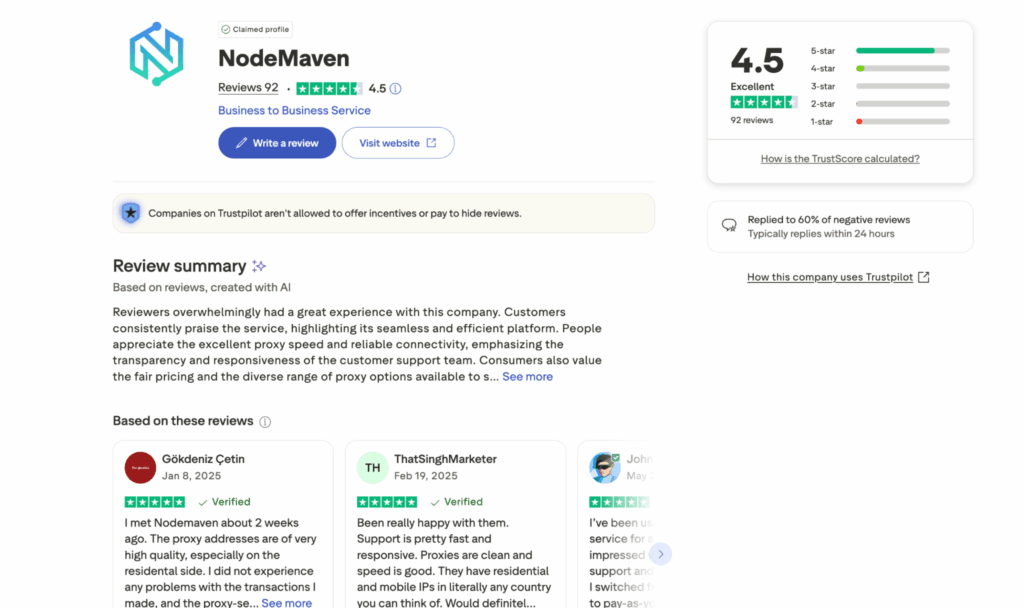
The company has 87 reviews on Trustpilot with an average rating of 4.3. I also noticed that NodeMaven reps have replied to 50% of negative reviews within 24 hours. That’s a sign that they are actively involved in customer support.
Concerning reviews, it is clear that customers appreciate this company for its clean proxies, speed, and customer support. Recently, NodeMaven has received praise for its low-fraud mobile proxies and the stability of its residential proxies.
Decodo Reviews
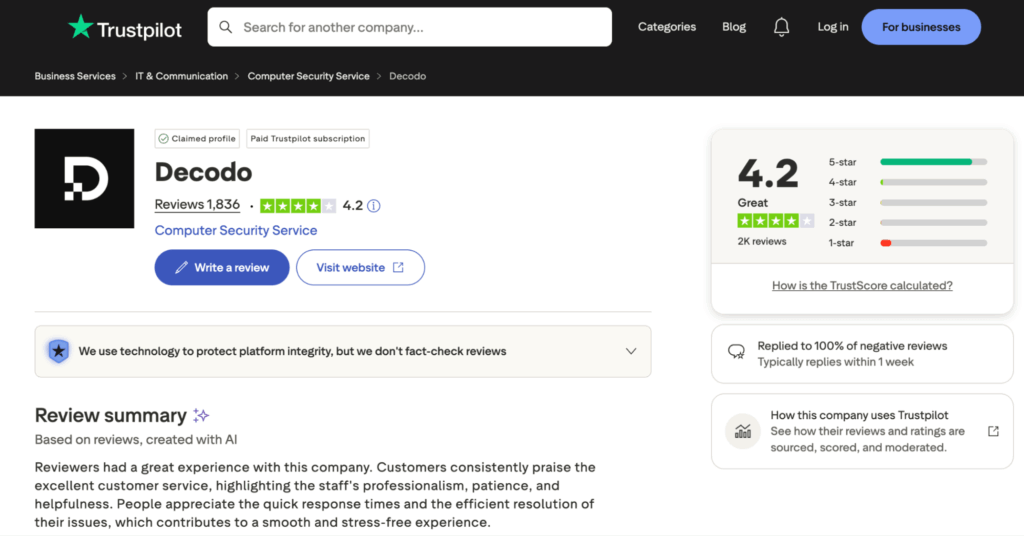
Decodo operates on a much larger review scale. This is clear from the fact that they have 1,835 reviews at their Trustpilot page, with a rating of 4.2.
The biggest pattern in Decodo’s reviews is support quality. Many users praise named agents for helping with plan changes, static residential or dedicated ISP issues, billing adjustments, and troubleshooting. Others mention proxy speed, reliability, and flexible subscription options.
Whose reputation is better?
NodeMaven looks stronger in specialist-style proxy sentiment: the praise is concentrated around the core things serious users care about most — clean IPs, stable performance, easy setup, and fast support. Decodo looks stronger in public scale and brand maturity: it has a much larger review base, broader visibility, and a more systematic review-response pattern. So the better reputation depends on what matters more to the reader: focused proxy trust or large-scale market proof.
Pricing Plans
NodeMaven
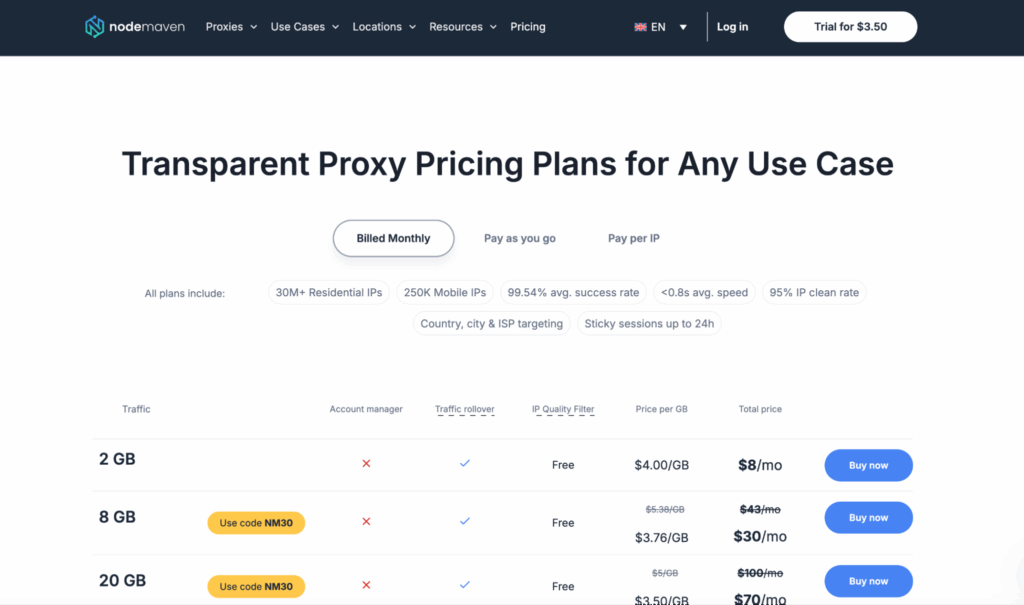
NodeMaven’s residential and mobile pricing starts with relatively small monthly tiers: 2 GB for $8/month, 8 GB for $30/month, 20 GB for $70/month, 40 GB for $125/month, 55 GB for $161/month and more.
It also highlights extras such as traffic rollover, an IP quality filter, and sticky sessions up to 24 hours, which are meaningful if your workflow is session-sensitive and you do not want unused traffic to vanish at the end of a billing cycle. There is no free trial, but NodeMaven does offer a paid test access for $3.50.
Decodo
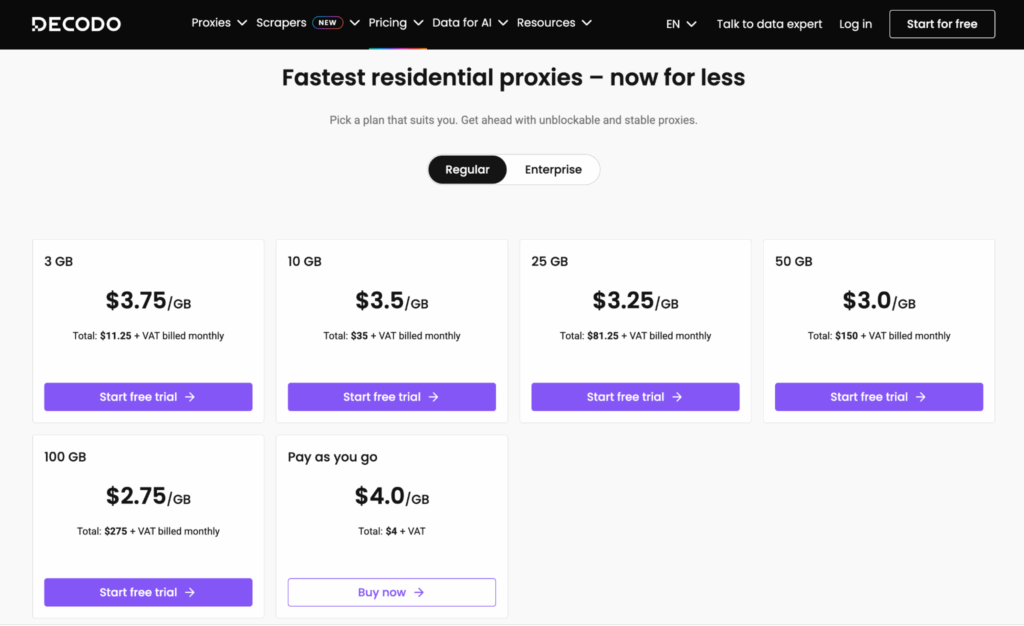
Decodo is easier to enter at the low end. Its residential proxy plans begin with 2 GB at $4 + VAT for the discounted monthly plan, then proceed to 8 GB at $14.5 + VAT and up to 100 GB at $148.5 + VAT.
For those who prefer not to subscribe, there is also the pay-as-you-go residential plan at $3.5/GB. The other plans start at $0.27/IP for ISP proxies, $2.25/GB for mobile, and $0.02/IP for datacenter. Furthermore, the provider also offers a 3-day free trial for residential servers.
Which one is more cost-effective?
If your priority is simply getting solid proxies with stable sessions, NodeMaven can justify its higher starting cost by wasting less traffic and less time on bad IPs or broken sessions. If you care more about low entry pricing, trial access, and the ability to expand into other proxy or scraping products later, Decodo is easier to justify on paper.
So in practical terms, NodeMaven offers better value for proxy-first users, while Decodo makes more sense for teams that want a broader toolkit under one roof.
Bottom Line: Which Provider to Pick?
NodeMaven and Decodo are both capable providers, but they solve slightly different problems. NodeMaven is the better fit if you want a proxy-first service with a stronger emphasis on session control, cleaner IP handling, and practical features like sticky sessions, rollover traffic, and focused anti-detect compatibility. Its current positioning, docs, and product pages are very clearly built around proxy performance in real operator workflows.
Decodo is more useful if you are after a broader platform with more than just proxies. It offers a much larger ecosystem where it could be simpler to integrate with wider scraping, automation, and data collection stacks.
To give you a better idea before making a decision, here are our full reviews of both services:
We use cookies on our site to ensure that we give you the best browsing experience. By
continuing to browse the site, you agree to this use. For more information on how we use cookies, see our Privacy Policy.