Proxy review · Clients Choice
Live Proxies Review: Proxy Types, Extras & Performance
I examined Live Proxies because it occupies an interesting position in the proxy market: a provider that sells direct B2C plans while positioning itself as an enterprise-grade network. That usually means one of two things. Either the service is mature enough to handle real operational traffic, or the marketing runs ahead of the actual product. On this page, I break down what services Live Proxies offers, which proxies are worth your time, what tasks they are suitable for, where the prices land, and which claims deserve a second look based on my experience.
 Clients Choice
Summary rank
How we score?Show detailsHide details
When analyzing the proxy, we have conducted in-depth research that helped us reveal all the strong and weak points of the service. Considering expert opinion and customer feedback, our pros studied the range of options and, finally, tested the service.
Analyzing the customer feedback
We have visited several forums devoted to proxy discussion and even participated in it. We have studied reviews on reliable resources with only one purpose – to make our review precise.
Getting to know the expert opinion
We have communicated with experts in the proxy industry. To uncover some hidden pitfalls, we asked professionals about its key features. In our review, we will tell you everything you need to know about the strong and weak points of the proxy provider.
Studying Terms & Conditions
At this point, experts have studied the legal basis. They have touched upon the place of registration, owners, achievement, reputation, and so on.
Exploring proxy types
To understand the quality of services the company provides, we test each of the proxy types it offers. The range of proxy types can vary as well as their quality.
Evaluating the quality of support
The support team reflects the reliability of the company hence it is essential to check it. We pay attention to response time, the communicative skills of managers, and the usability of the service.
Testing the service
We have checked the proxy provider backwards and forwards. To make our research full and deep, we have tried out all proxy types offered there.
Comparing
Our experts have compared this proxy with other popular services — pricing, features, and characteristics. You can find more in the Comparison section of the website.
What is best suited for?
- Public-surface monitoring, brand protection, ad verification, controlled web scraping, and other location-sensitive web tasks that need residential or carrier-origin IPs.
We liked
- Private IP allocation instead of a large shared pool
- Strong fit for brand protection, ad verification, and search-result testing
- Real-world residential and mobile proxies with solid quality
- Helpful dashboard for quick access, usage checks, and proxy retrieval
- Unlimited traffic B2C plan options on selected services
- Useful Help Center with detailed setup notes and curl-based HTTP proxy checks
- B2B trial available for qualified businesses
- Good reputation signals on Trustpilot and G2
- 24/7 support across multiple channels
We didn’t like
- Public documentation is not always fully consistent when describing features
- Entry-level proxies are not cheap
- Enterprise depth is stronger than what casual buyers get on day one
Characteristics
- Mobile IPs (Verizon and AT&T)
- Residential proxies
- English
- 55+ countries worldwide, with strong coverage in the US, UK, and Canada
- Rotating Residential Proxies
- Dynamic mobile proxies
- SOCKS5
- HTTPS
- PayPal
- Stripe (Тier-1)
- Zelle
- Compatible with major scraping tools and custom enterprise workflows
- Standby rollover for unused data on eligible plans
- IP whitelisting for tighter source control
- A separate B2C proxy dashboard and B2B workflow with the same provider
- API access for enterprise users
- State-level US targeting on selected offers for specific IPs
- Compatibility with major automation and data scraping stacks
- Proxy tester, curl-based validation docs, partner ecosystem pages, and notes on locations
- Discord and ticket-based support beyond standard site contact paths
Live Proxies stands out because it tries to serve 2 audiences at once. On one side, you get straightforward B2C checkout for residential and mobile proxies across multiple use cases. On the other, you get a more controlled B2B layer with API access, custom onboarding, broader targeting, and a qualification-based trial. That matters because many proxy vendors talk about “enterprise” while really selling the same solution at a higher price. Here, the split looks more deliberate and better suited to real-world traffic management.
From a cybersecurity angle, I also paid attention to the operational details, including SOCKS5 availability. Live Proxies publicly documents IP whitelisting, blacklist handling, curl-based testing, encrypted payment flows, and some abuse controls. That does not prove the proxies are perfectly secure, and it definitely does not mean they are undetectable in all cases. But it does show that this proxy provider is thinking beyond pure sales copy.
My view of Live Proxies is positive, but not blind. For most users, that balance will matter. The core quality of their proxies looks strong, and the network stability is hard to miss. But the documentation needs tightening. If you buy this proxy solution, buy it for its clean infrastructure and controlled traffic.
Featured
Rotating Residential
Live Proxies positions these premium proxies as the backbone for web collection, ad checks, brand protection, and platform validation. This type of offer is suitable for high-volume traffic, repeatable checks, and workflows that need a steady success rate. For those jobs, a household proxy with believable addresses, broad country coverage, decent HTTP session control, and dependable quality is usually more valuable than a cheaper network that burns out fast.
The strongest part here is the balance between scale, practical use, overall quality, and the usable pool. Public material points to millions of IPs across 55+ locations, with strong coverage in the US, UK, and Canada. That is enough for multi-region scraping, monitoring, and geo checks without making the network feel artificially narrow across locations. It also helps that Live Proxies still presents sticky HTTP sessions as a real workflow choice instead of pretending every job needs unlimited rotation.
My caution is simple: verify the exact features, authentication path, and B2C/B2B feature split before you buy a plan. The company speaks the language of advanced users, but the public pages do not always explain those edges with the same precision. Still, as a premium proxy provider, this is the option that best fits serious validation and scraping work for most buyers.
Static Residential
Static residential proxies fill a different role. These IP addresses are less about rotation and more about the continuity they provide. If your task needs the same identity over time (repeated sign-ins, storefront checks, long-lived HTTP sessions, stable monitoring from one location, or near-unlimited continuity), then a static proxy is usually the better option.
Right now, this product exists publicly, but the B2C pricing page can show it as sold out depending on location. So keep in mind that it might not be the easiest line to buy on demand at all times.
What I like about static IP coverage here is that it solves a real problem without a visible drop in quality. Certain web platforms punish abrupt rotation. Some workflows break when the proxy address changes mid-stream. In those cases, clean persistence beats raw volume. That is where static residential proxies still have value.
Rotating Mobile
Mobile is the more specialized branch of the lineup. You buy it when carrier-sourced IPs are the point, not when you simply need cheap bandwidth. Live Proxies positions these premium proxies around app testing, mobile ad checks, localization review, and mobile-focused data work. That is the right framing, because mobile proxies are a targeted instrument.
The practical appeal is that mobile-origin traffic can behave differently from desktop-looking traffic. Some web platforms treat it differently, and defenses may tolerate it longer. Mobile-only checks can make more sense when the proxy provider gives you carrier-style addresses rather than standard residential ones for a specific country setup.
I would keep expectations disciplined. Mobile addresses usually cost more, and the public B2C page does not present them as an unlimited data line. So reserve it for the jobs where it can provide you with a measurable edge. Used that way, these proxies could add real value to this provider’s catalog.
How to Use Live Proxies
If you have used premium proxy services before, the workflow is easy enough. If you have not, open the Help Center alongside the dashboard from the start. This directory of searchable articles and detailed guides can help you avoid setup mistakes, especially around whitelisting and authentication. The documentation is most useful when it explains the basics, such as how to sign in, validate a proxy over HTTP, and troubleshoot early connection issues.
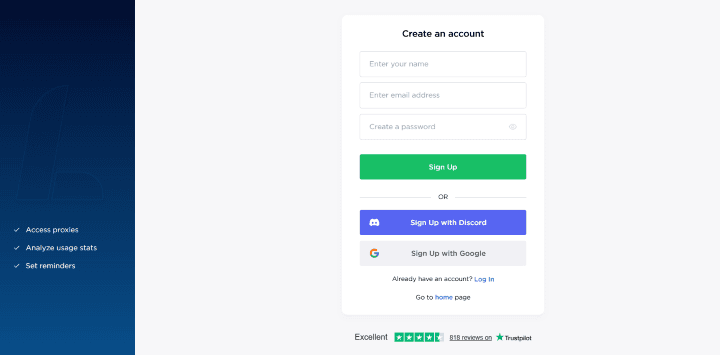
Register an account
Click “Sign Up”, complete the form, or use a linked sign-in option. The current registration flow also supports social methods, which lowers friction for first-time users.
Decide on the plan
Choose between dynamic residential or mobile proxies. Match the plan to the job. Repeated workflows need consistency, while broader collection jobs need larger rotation, more flexible targeting, and sometimes unlimited bandwidth.
Complete checkout
Standard checkout runs through Stripe over encrypted HTTP. For larger customers, Live Proxies offers PayPal or Zelle on B2B custom billing. If a coupon is live, apply it before payment.
Retrieve and configure your proxies
Open the dashboard, copy the list, choose the right auth method, and set IP authorization if your setup needs it. This is also the point where you should confirm the intended country, protocol path, SOCKS5 support, exit IPs, and locations list.
Run a small validation pass
Start with curl or the tester docs, not full-volume deployment, especially when checking encrypted requests. Confirm the exit address, verify auth, and watch how the first HTTP sessions behave and what success rate they deliver. The Help Center’s curl example is exactly the kind of detailed baseline check I like to see when verifying connection quality.
Scale carefully
Once the first checks look okay, move to your real toolchain. Watch bandwidth, expiry, and usage from the dashboard platform. Good proxy management means controlling traffic, not just buying more proxies.
Integrations
Live Proxies can be integrated with common automation and data collection tools. The supported integrations include Playwright, Puppeteer, Selenium, Scrapy, BeautifulSoup, Octoparse, as well as a partner ecosystem of antidetect browsers and automation tools. From a technical perspective, this is a sensible way to structure it. That is, the proxy provider handles the routing of the traffic, and the user decides how the rest of the stack works.
What I like is that the provider also publishes detailed how-to content around some of those environments for multiple workflows. What I like less is that some integration-related pages still say “coming soon,” especially for browser and extension workflows.
Performance Testing
I tested Live Proxies in three stages. First, with a direct curl check using the HTTP proxy endpoint. Then, with repeated connection requests through a browser automation stack. Finally, with exit-IP validation across multiple country targets under average workload conditions. I was looking for 3 things: stable auth, believable average response time, and a strong success rate once the traffic stopped being toy-level. That is the only way to judge quality in a proxy review that claims real operational value.
Usability
Usability is one of the cleaner parts of the Live Proxies pitch, and that improved my overall experience. The account dashboard is not flashy, but that works in its favor. You can see the active plan, remaining bandwidth, time left, proxy retrieval area, and IP authorization without wandering through a bloated interface. The checkout screen is also refreshingly plain, which I prefer in a proxy service that handles sensitive traffic. Fewer distractions. Less room for confusion.
The weak point is documentation consistency. Some parts of the Help Center are genuinely useful and detailed. But others still carry “coming soon” labels. So the day-to-day experience is good, but the documentation still needs polish and better quality control. Even so, compared with many smaller proxy vendors, this one is easy to understand and fast to work with.
Pricing and Payment Methods
This is a premium proxy provider, and the pricing reflects that. Current B2C pricing shows dynamic residential from $70 and mobile from $70. Enterprise plans start at $2,000 per month for 1 TB and scale based on volume and IP pool size, which puts it above the average entry point. That makes Live Proxies less attractive for bargain hunters and more attractive for buyers who care about cleaner IPs, better quality, and predictable traffic behavior.
Product | From / Tier | Notes |
Dynamic Residential | from $70 | 4 GB / 30 days on current B2C page |
Static Residential | variable / sold out | Proxy availability can change |
Rotating Mobile | from $70 | 4 GB / 30 days on current B2C page |
Enterprise | from $2,000/mo | 1 TB start, API, custom targeting, and a larger pool of proxies |
Standard checkout uses Stripe over HTTP and supports cards plus wallet methods, while B2B custom clients may also get PayPal and Zelle. There are also coupon codes, occasional time-bound discounts, and rollover on eligible plans, so some buyers may get better value from the same plan or from unlimited options when available.
Customer Service
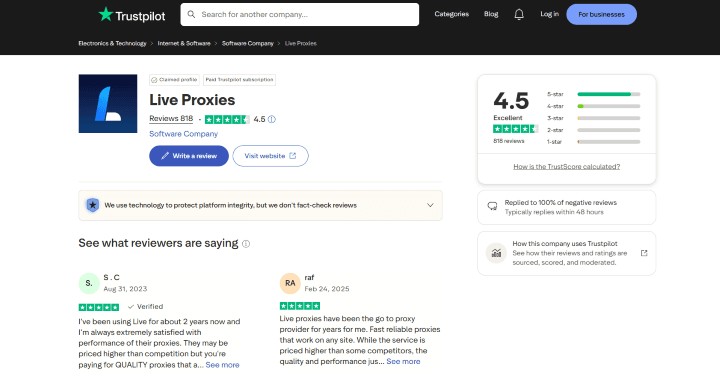
Customer support is one of the more credible parts of the offering, with a response pattern that looks reassuring. Live Proxies publicly points users to the Help Center, ticket submission, Discord, email/contact paths, and Trustpilot activity that shows the company engages with complaints rather than ignoring them. That is exactly what I want from a proxy provider that sells platform infrastructure rather than a simplified consumer tool.
The best part is that the first line of help is not a chatbot wall. You get self-serve articles for payments and auth, then a path to a human when the issue gets more technical. My main criticism is simple: parts of the Help Center’s integration section are still marked “Coming soon”. Close those gaps, and this becomes a stronger all-around customer care operation than most proxy services at this size.
Our Verdict
Having tested Live Proxies, I can say it looks like a premium proxy provider. I like the private allocation model, the useful dashboard, and the fact that the company provides a believable bridge between self-serve buyers and enterprise users. I appreciate the rotating residential line most for its quality, while mobile is the more specialized option, and static remains useful but availability-sensitive.
What needs work is the public documentation. Descriptions of sticky sessions, SOCKS5 support, protocols, and feature wording should be more consistent. I would recommend this proxy solution to users who need proxies for monitoring, validation, and disciplined data scraping. Those whose only filter is price may want to look elsewhere.
FAQ
What social networks is Live Proxies suitable for?
Live Proxies is suitable for public-page checks, moderation research, location testing, ad verification, and low-noise data scraping on social networks such as X, LinkedIn, Instagram, TikTok, and YouTube. I would recommend using this proxy provider for visibility and validation, not for aggressive automation that risks account or platform penalties.
Does Live Proxies offer a free trial service?
Yes, but only in a controlled way. The public enterprise FAQ says the provider offers free access for qualified businesses with a verifiable presence and a legitimate use case. So this is not a broad B2C sample. It is a filtered B2B trial tied to real operational needs.
How can I use Live Proxies for web scraping without getting blocked?
Start with rotating residential proxies and keep your request rate and concurrency modest, then scale only after a clean test run. Use rotation (or short sticky sessions) and vary headers/timing. If blocks persist, adjust targeting and fingerprinting.