Research note
Top 5 Reasons to Use a Proxy

Two essential questions keep bothering ordinary users to this day. Firstly, how to access locked resources? Secondly, how to stay anonymous? With a proxy server, you can have these issues covered along with additional ones.
Briefly about proxy servers

What is a proxy server?
A proxy server is a service that acts as an intermediary standing between the user and the server. The application provides an indirect connection that helps to access locked resources. Besides, it helps to keep your data secret.
When surfing the Internet, you enter a query in the search bar and connect the site directly. The site gets your IP and consequently your geographical location, files you downloaded, and time you spent on there.
Hence, we face two crucial issues:
Possible attack on your PC based on vulnerable points of the system
Possible detection of your physical location
A proxy server is the greatest solution for these purposes. It functions on behalf of the user when requesting service masking its origin.
At the moment, there are over 1,000 proxies used in 54 different countries. This number is growing at an incredible pace which indicates an increasing demand for these applications.
How do proxies work?
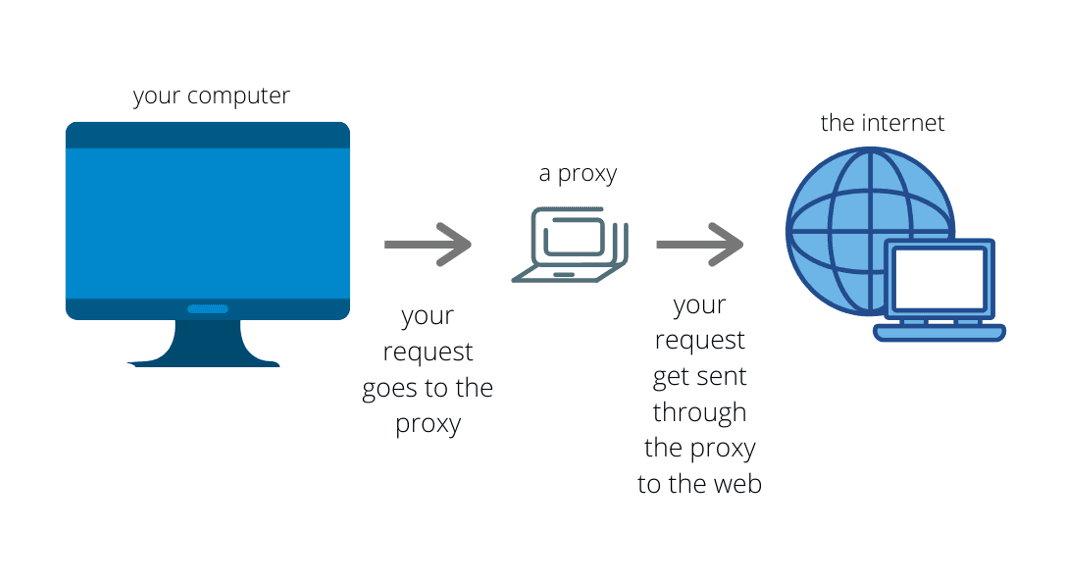
The principle of proxy operation consists of 3 stages:
The user connects the proxy server and requests the desired site;
The server connects the site you want to visit and takes the resource from it;
It keeps your data secret and provides you with the required information.
With it, you can:
improve network security by encrypting requests;
prevent the interception of confidential information;
block malicious websites and ads;
cache sites to save traffic;
monitor the use of the network channel;
block domains;
monitor and registration of web requests;
test web resources when logging in from different IP addresses.
To get more information, follow the link.
5 reasons to use a proxy
Provides anonymity
Visiting sites, you disclose information about your PC. Here, you can see some information you provide when surfing the Internet.
IP address, operating system, browser, and location are general information available to all sites on the Internet. If desired, you can get a huge amount of information about the users with their IP addresses.
Proxy server reduces this problem. As you set it up, sites stop seeing your data. They see only the IP address and location of an intermediary. Thus, you stay anonymous and keep your data secret.
Keeps security
Well, if the site is a legal and reputable one, there is no need to worry about your data. But the Internet is full of fraud and scams. It is very easy to fall for the trick of even inexperienced hackers.
If you run into so-called phishing sites, this data will come to hackers. A phishing site is a bait that attracts users for scammers to get user identification data. As you enter such a site, you convey all information about your PC and give access to your computer.
Besides, hackers search for computers with open ports. Open ports help the hacker access the computer and set up a Trojan onto the system or another type of infected software. Thus, the hacker gets full access to your computer and can control it.
To protect your computer against this invasion, you can install a firewall. But if you don't know how to configure it, some ports may remain accessible to intruders. When using proxies, the hacker does not know your real IP, and therefore, he cannot scan your computer.
Provides access to locked resources
Using a proxy, you can access almost all locked resources, such as torrents and streaming services. Due to the fact that it hides your geolocation, sites do not see your location and hence can’t forbid you access.
If you do not need anonymity during normal work on the network, then proxies are for you. You can use specialized intermediaries that focus on specific tasks and are cheaper than conventional ones.
Maintains the connection rate
Good proxies have almost no effect on the connection speed, and sometimes even speed up the connection rate.
When setting up a VPN, you can use only those servers that are in the program. And the nearest server may be in another country. As you know, the speed of data transfer between servers strongly depends on their geographical location.
The difference in the ping of a couple of tens of milliseconds does not seem important. But if you play online games, you will notice this difference.
When choosing a server, you can pick the one closest to you and save connection speed.
Saves the device energy
Proxies, unlike VPNs, are not a program, but a setup on a computer or in a program. When you start a VPN on your smartphone, you will immediately notice an increase in battery consumption. The same will happen with the computer. VPN is another service that needs the energy of a device.
With it, you specify the connection parameters in the system or program. All the work of the program takes place already through a proxy server without consuming unnecessary resources.
Types of proxy servers
Transparent
It is the simplest type. The browser doesn’t register the intermediary settings. The server simply intercepts incoming HTTP traffic. The user doesn’t notice its presence.
Anonymous
These proxies never transmit the client's IP address to the target resource. If you don't want targeted ads to follow you or your location, it is a good variant. Proxies of high anonymity convey neither IP address nor personal data and do not identify themselves as a proxy.
The IP address changes periodically during the operating time. Since the IP is changing, it is extremely difficult to track the source of requests.
Distorting
It works similarly to an anonymous one but transmits a deliberately false IP address. If you need to circumvent local restrictions on access to content it is the best option.
Residential
This proxy uses real IP addresses. For servers, they look like regular clients. The opposite of a resident intermediate is a data center one that has IP addresses not tied to a real device.
Public
It is the most insecure and unreliable type of proxies. They can "fall off" at any moment and are vulnerable to hacker attacks.
Private
Private servers can be transparent or have high anonymity, but access is available only to one user.
Shared
It is one of the cheapest types of servers. Here you divide the cost of a rented intermediary with other clients who get simultaneous access to it.
Rotating
It allocates a new IP address for a new client. One IP is available only once. The rotary server provides a high level of security and confidentiality.
SSL proxy
These proxies work on the principle of HTTPS which protects requests by encryption.
Reverse
It hides the IP address of the server that receives the request. The tool helps to control access to the server and reduce traffic by caching information.
To sum up
Using a proxy is useful for hiding or protecting information. The main features of intermediaries are:
internet data security and privacy;
ability to bypass geolocation-related restrictions;
the ability to improve network performance;
ability to control access to sites.